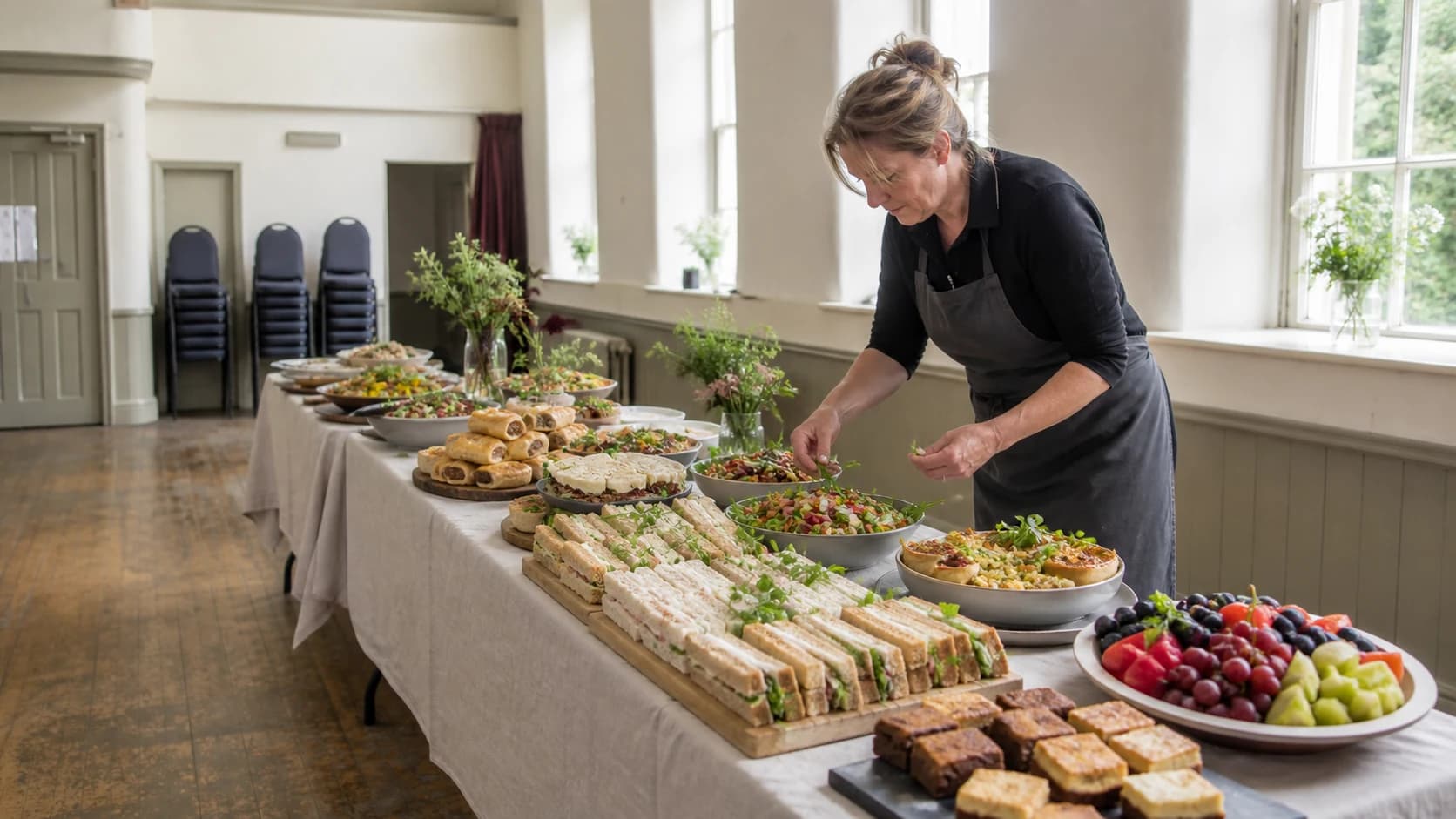
Village halls are our bread and butter — christenings, wakes, birthdays, committee dos and the annual quiz. They are also the venue type where the awkward surprises live, because every one is different and the person who knows how it works is usually a volunteer who is not there on the day.
Run through these before you book anybody, and the rest tends to look after itself.
1. How early can you get in?
Ask for the actual hour, not "the morning". Halls are often double-booked with a playgroup or a yoga class, and a two-hour set-up window that turns out to be forty minutes is the commonest cause of a rushed table. A buffet needs two hours on site; anything off a grill needs three.
2. How many working sockets are there — really?
Not how many sockets exist. How many work, and whether they are on the same fuse as the urn and the disco. Hot fork buffets use chafing dishes that need very little, and we bring our own gas where a hall cannot supply anything, but it is worth knowing before the lights go out during the speeches.
3. Can we cook outside, and where?
The grill has to be outdoors — no insurer would look at one inside a hall, and neither would we. Grill outside, serve inside is a completely normal arrangement and it is what we do at most halls. What you need to confirm is that there is somewhere to pitch and that the committee is happy about it.
4. Does the committee want to see paperwork?
Most do, and they are right to. Ours goes out with your invoice as standard: public liability insurance, Level 2 food hygiene certification for all staff, local authority registration, a risk assessment and method statement written for outdoor cooking with LPG, and a HACCP plan. Give us the hall's email address and we will send it all directly, a month ahead rather than the night before.
5. Where does the van go?
Halls often have a car park that fills with guests by the time food arrives. Reserve two spaces near the door, or tell us to arrive before the guests. Carrying chafing dishes ninety metres across gravel is possible; it is just slower and less dignified than it needs to be.
6. What is the kitchen actually for?
Village hall kitchens are usually built for making tea for forty, not for plating for a hundred and twenty. We treat one as a useful bonus rather than a plan: somewhere to wash hands and set down trays. If it has a working fridge, wonderful. We bring our own regardless.
7. How many tables, and how big?
For a buffet, allow roughly a two-metre table for 25 to 40 guests and about four metres for a grazing table. Halls tend to have plenty of trestles but they live in a cupboard that somebody has the key to. Worth establishing who.
8. What time does the hall have to be empty?
This one catches people out. If your hire ends at eleven and clear-down takes forty minutes, service cannot run to half past ten. Tell us the hard stop and we build the timings back from it.
9. Who is dealing with us on the day?
Name one person, ideally not the host. At a wake in particular the family should not be finding the caterer to ask about timings. Give us a name and a mobile number and we will deal with them and leave you alone.
A note on wakes
We cater a good number of these and take particular care over them. We will liaise with the hall or the funeral director directly, arrive and set up before anyone returns from the service, keep the table topped up discreetly and leave without needing to be found and thanked. If you would rather not work through menus at all, tell us the numbers and a budget and we will propose something.
The menus this article is about
Written by Adam Skinner, who has cooked professionally for 30 years and is the one who turns up. Questions about any of this? Ask him directly or ring 07946 773421.