Hog Roasts
Hog roast catering, cooked where you are standing
- £22.50
- From, per head
- 60+
- Guests
- 3
- Menus
- 60 mi
- Travel included
The detail
Seven hours of fire for four hours of eating
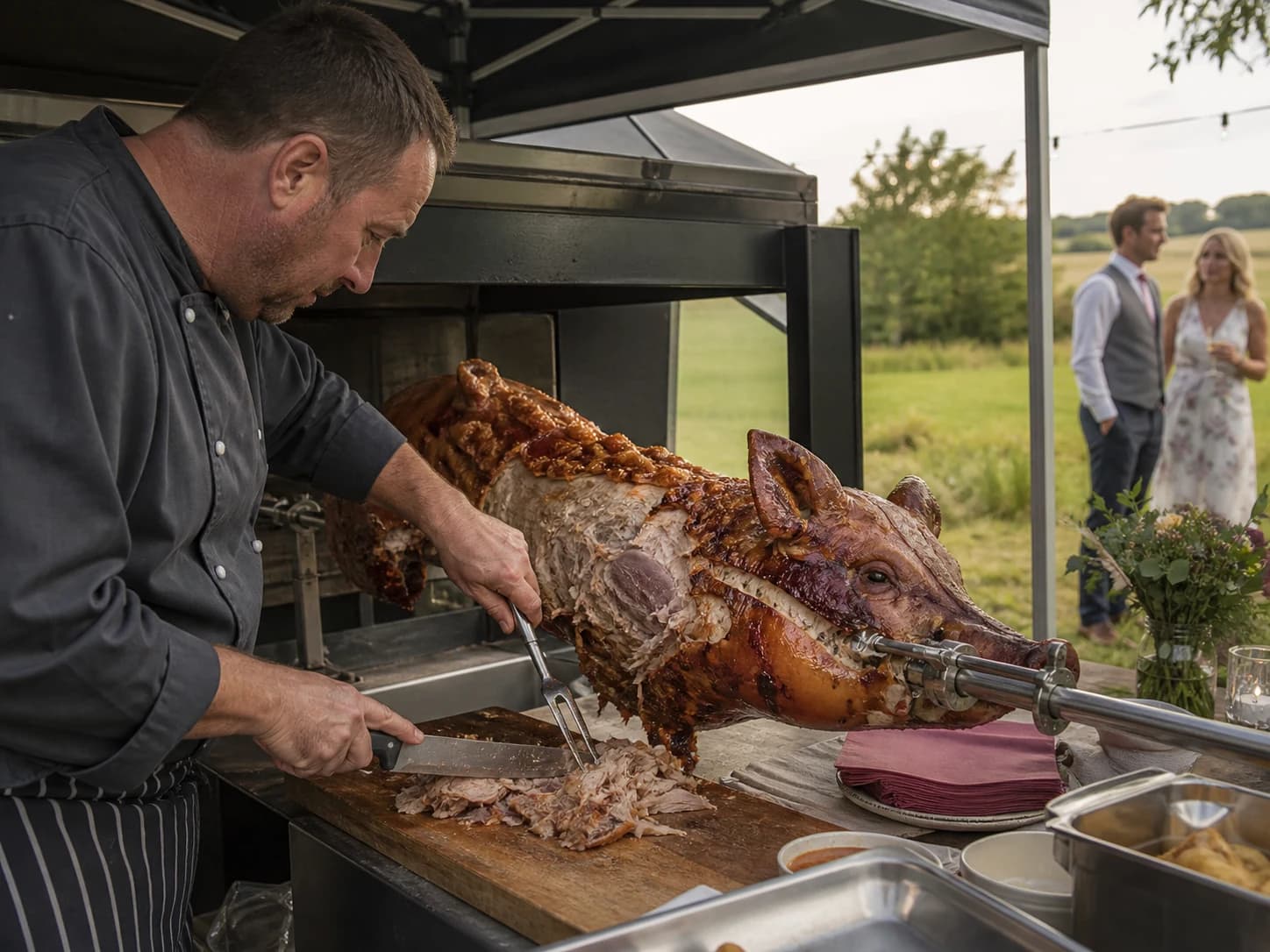
A hog roast is the most theatrical thing we do, and the least complicated. One animal, one fire, a long slow day, and a chef who does not walk away from it. The pork is free-range and local, scored and dry-salted the night before so the skin gives up its water, then turned on a gas-fired spit for a full seven hours until the fat has rendered and the crackling snaps rather than bends.
It goes on at your venue, not in a unit on an industrial estate. That matters for two reasons. The obvious one is smell — an afternoon of slow pork drifting across a field does more for an appetite than any canapé. The less obvious one is quality: pork that is carved straight off the bone in front of a queue has never been chilled, portioned, reheated or held in a chafing dish, and it tastes like it.
Service is a moving queue rather than a sit-down. Adam carves, someone else builds the bap, and 150 guests are fed in about forty minutes without anybody feeling processed. Then the carving board stays open all evening, which is when the second helpings and the crackling cones do their real work.
Why the crackling is the test
Soft crackling means the skin was wet, the fire was cool or the hog was rushed. It is the one thing you cannot fake at the last minute, and it is the first thing Adam checks. Thirty years and it is still the bit he is judged on.
Benefits
What a hog roast gives you that a buffet cannot
A centrepiece that entertains itself
The fire is the focal point of your event for hours before anyone eats. Guests gather round it, ask questions, take photographs and stop needing to be entertained. It replaces a whole slot in your running order.
It feeds a lot of people, properly
Pound for pound it is the most food we put in front of a guest. A whole hog scales far better than portioned dishes, which is why 200 guests eat properly here for what a plated three-course would cost for 80.
The queue is fast and never runs dry
Carved to order means no tray sitting under a lamp going grey. It also means service starts the moment you want it to and stretches to cover late arrivals, speeches that overrun and a photographer who lost twenty minutes.
Late-evening food, already solved
The board stays open. What is left becomes the 10pm round of baps that stops a drinks reception turning into a taxi rank, at no extra cost and with no second delivery.
Menus
3 hog roasts menus
The Classic Hog
The one that built the business. Carved to order, all evening.
- Whole slow-roasted free-range hog, carved by the chef
- Fresh floured baps and artisan rolls
- Bramley apple sauce and our house sage and onion stuffing
- Crackling served in paper cones
- All service equipment, gazebo and waste removal
Minimum 60 guests
Get a price for thisThe Full Feast
Hog roast plus a table of salads and sides that earns its keep.
- Everything in The Classic Hog
- Four seasonal salads, dressed on site
- Herb-roasted new potatoes with garlic butter
- Homemade coleslaw and pickled red cabbage
- Crockery, cutlery and linen-dressed serving tables
Minimum 60 guests
Get a price for thisThe Cambridge Banquet
Full service, front to back — arrive as a guest at your own party.
- Everything in The Full Feast
- Second meat: slow-cooked beef brisket or spiced lamb shoulder
- Grazing board on arrival — charcuterie, cheese, breads
- Two desserts plus tea and coffee service
- Uniformed front-of-house team for the full event
Minimum 80 guests
Get a price for thisThe process
The order of the day
- The night before01
Scored, salted and rested
The hog is prepared at base — skin scored in tight lines, dry-salted and left uncovered overnight so the surface dries properly. This is the step that makes the crackling, and it cannot be hurried on the day.
- 11:3002
On site and lit
We arrive, set the gazebo, build the fire and get the hog turning. From here it is unattended for exactly none of the next seven hours.
- Through the day03
Turned, basted, watched
The burners are adjusted through the cook rather than set once and left. The hog is turned to even out the render and the skin is worked as it tightens. Meanwhile the salads, sauces and sides are prepped on site.
- Two hours before04
Sides out, tables dressed
Serving tables go up and get dressed, sides come out, apple sauce and stuffing are finished. If your package includes front-of-house, they arrive now and get briefed on the room.
- Service05
Carved to order
Adam carves, the queue moves, and crackling goes out in paper cones alongside. Vegetarian, vegan and allergen plates are handed over separately, away from the main line.
- Afterwards06
Board open, then gone
The carving board stays available for second helpings and late arrivals. We box what is safe to keep, clear our area completely and take every scrap of our waste with us.
Suited to
What people book a hog roast for
Wedding receptions
Relaxed weddings that want the food to be a talking point rather than a formal course. Works particularly well with an evening ceremony and a long drinks reception.
Village and community events
Fêtes, beer festivals and jubilee-style street parties. High volume, honest price, and the fire draws people across a field.
Milestone birthdays and anniversaries
Sixtieths, seventieths and silver weddings, where the guest list is broad and everyone from a toddler to a grandparent needs to find something they will eat.
Farm, barn and marquee parties
Sites with no kitchen at all. We are entirely self-sufficient, so a bare paddock is no harder for us than a village hall.
Corporate summer parties
Family days and staff summer events where a hog roast reads as generous without reading as extravagant.
Requirements
What we need from your venue
- Space
- About 5m × 3m of level ground for the roaster and gazebo
- Access
- A route a long-wheelbase van can reach, ideally within 30m of the pitch
- Power
- None — we bring our own gas, generator and lighting
- Water
- None — we carry our own, though a tap nearby is welcome
- Time on site
- Seven hours before service, so late-morning access is essential
- Minimum guests
- 60, because a whole hog needs the numbers to make sense
Included in every hog roast package
- Whole free-range hog, prepared the night before and cooked on site
- Chef carving throughout service, not a member of staff on a rota
- Fresh floured baps, artisan rolls and gluten-free alternatives
- Bramley apple sauce and house sage and onion stuffing, both made from scratch
- Crackling served in paper cones alongside the carving board
- Gazebo, gas, power, refrigeration, lighting and hand-washing facilities
- Serving tables, dressed, with disposable service ware as standard
- Full clear-down of our area and removal of all our waste
Questions
Hog Roasts — the questions we get asked
How big a hog do you need for my numbers?
Roughly speaking, a 45kg hog feeds 80 to 100, and a 60kg hog feeds 120 to 150. Adam sizes the animal to your confirmed numbers rather than to the package, so you are never paying for meat nobody eats — or short at nine o'clock.
Can we see the hog being carved?
That is rather the point. The roaster is set up where your guests can gather round it, and Adam is happy to be asked questions all afternoon. If you would rather it were tucked out of sight for photographs, tell us and we will pitch elsewhere.
What about guests who do not eat pork?
Every hog roast package includes a proper alternative, not an apologetic salad. Vegetarian and vegan mains are cooked separately and handed over away from the carving queue. If you have a large number of halal guests, the barbeque menus are usually the better fit and Adam will say so.
Is 60 guests really the minimum?
For a whole hog, yes — below that there is more animal than event. But a shoulder or a rolled loin roast does the same job beautifully for 30 to 50 people, and it is a genuinely lovely thing. Ask and we will quote it.
Do you need to start that early?
Yes. Seven hours is not padding; it is what turns a tough, fatty animal into something that pulls apart. Anyone offering a whole hog in three or four hours is either cooking a very small one or serving you something disappointing.
Can the hog roast run alongside a barbeque?
Frequently. A hog for the main service and a grill for late-evening food is a popular combination for weddings, and it costs less than you would think because the team and equipment are already on site.
Alternatives
Might another menu suit you better?
Next step
Price up a hog roast
Pick a date and a headcount and the quote builds as you go — per head, extras, deposit and balance, all before you commit to anything.
Adam Skinner answers his own phone — no call centre, no sales team.